AI Solutions for Business: How to Close the 88% Adoption, 12% ROI Gap
88% of organizations use AI, but only 12% of CEOs report real ROI. A function-by-function implementation guide covering tools, frameworks, and company-size play
Updated 15 min read
88% of organizations now deploy AI in at least one business function, yet only 12% of CEOs report AI delivering both cost savings and revenue growth. AI solutions for business span four categories in 2026: enterprise platforms (Microsoft, Salesforce), horizontal AI assistants (ChatGPT Team, Claude for Work), SMB tools, and agentic AI platforms now moving from pilot to production.
The gap between surface AI use and ROI-generating AI is not about which tools you buy. Merck and Mastercard both credit data infrastructure, not model choice, as the reason their agentic AI deployments work. This guide covers what the categories are, how implementation actually works, company-size-specific playbooks no top SERP article addresses, and the eight failure patterns behind the 80.3% project failure rate.
Key Takeaways
88% of organizations use AI, but only 12% of CEOs report both cost savings and revenue growth. The gap is implementation approach, not tool availability.
Agentic AI deployments average 171% ROI. Unstructured AI approaches average 5.9%. A 29x difference driven by infrastructure investment and workflow redesign.
Infrastructure-first is the critical success variable. Merck and Mastercard credit clean data architecture, not model selection, as the reason their AI works.
Context engineering outperforms prompt engineering. Shopify CEO @tobi defines it as "the art of providing all the context for the task to be plausibly solvable by the LLM."
SMBs, mid-market, and enterprise organizations need distinct AI strategies. Your entry point, tool stack, and success pattern depend on company size, not just ambition.
What Are AI Solutions for Business?
AI solutions for business are software systems that use machine learning, large language models, and automation to handle business tasks. They draft documents, run supply chain and financial workflows, and manage customer service queues at scale without human intervention.
Horizontal AI assistants work across any business function and any team size. ChatGPT Team and Claude for Work both run at $25/user/month. These copilots dominate enterprise AI spend, accounting for $7.2B of the $8.4B horizontal AI market in 2025.
SMB and departmental tools are function-specific products accessible to smaller teams: HubSpot Breeze AI for CRM and marketing, Notion AI at $20/user/month, Zapier from $19.99/month, and Grammarly Business at $15/user/month.
Agentic AI platforms are autonomous systems that execute multi-step workflows without human direction. This is the fastest-growing category, shifting from demos to production in 2025. Salesforce Agentforce, Microsoft Copilot Studio, and Zapier Agents are the accessible entry points; LangChain/LangGraph powers custom enterprise deployments.
Why AI Solutions for Business Matter in 2026
The horizontal AI market reached $8.4B in 2025, up 5.3x year-over-year. Agent platforms hit $750M, the fastest-growing segment. Vertical AI spending reached $3.5B, nearly tripling from $1.2B in 2024.
Klarna replaced 700 customer service agents with a single AI system, saving $60M annually. JPMorgan's COiN system eliminated 360,000 lawyer-hours per year of contract review.
C.H. Robinson automates 5,500 shipments daily using LangChain agents.
The gap between those outcomes and the 56% of CEOs reporting zero financial impact from AI investments is an implementation problem, not a tool availability problem.
How AI Solutions for Business Work: The Three-Tier Model
Where your organization sits in this framework determines your ROI ceiling more than which tools you choose.
Tier
Share of AI-Adopting Orgs
Description
Typical ROI
Tier 1: Surface users
~59%
ChatGPT/Copilot for ad-hoc tasks. No workflow change, no measurement.
Near-zero to negative
Tier 2: Productivity users
~29%
AI integrated into specific workflows with baseline tracking
Positive return per dollar invested
Tier 3: Agentic users
~12%
Autonomous AI agents in production, multi-step workflows
171% average ROI
Tier 1: Surface Users
You use ChatGPT or Microsoft Copilot for ad-hoc tasks: drafting emails, summarizing documents, generating copy. Workflows have not changed. Without measurement, the result is near-zero to negative ROI: the AI augments individual tasks without compressing costs or improving outcomes at the system level.
HBR research from February 2026 puts the pattern clearly: employees use AI tools as one-off experiments without changing how work is structured. The tool changes. The workflow does not.
Tier 2: Productivity Users
Tier 2 organizations integrate AI into specific, measured workflows. They connect AI to real data, define success metrics, and track outcomes. The move from Tier 1 to Tier 2 is primarily organizational: document the workflow before deploying AI, measure the baseline, and attribute outcomes to the AI integration.
Tier 3: Agentic Users
Tier 3 organizations run AI agents in production: systems that execute multi-step workflows autonomously, interact with external tools and databases, and operate at scale without human oversight. Average enterprise ROI here is 171% ROI, with 74% of executives achieving ROI within Year 1. U.S. enterprises specifically average 192%.
Compare that to average AI ROI without a structured approach: 5.9%. The mechanism separating these outcomes is not model capability. It is workflow redesign and data infrastructure.
AI Solutions by Business Function
Customer Service and Support
Customer service is the most mature AI deployment category because the ROI is direct and measurable. Fully automated FAQ resolution, AI-assisted human agents, and agentic resolution of complex queries represent a spectrum of deployment options.
Zendesk AI increases automated resolution rates by 23% and reduces time-to-first-response by 16%. Unity, using Moveworks, cut IT resolution from 3 days to under 1 minute with 91% employee satisfaction.
Alex Hormozi describes the agentic version at scale: "When we did our book launch, we spun up five agents that handled somewhere in the neighborhood of 120,000 support tickets. We were able to resolve 90% of all tickets without any human intervention." (Alex Hormozi, YouTube, May 2026)
For most businesses, the entry point is connecting HubSpot Breeze or Intercom's AI to your FAQ knowledge base. Resolution rates for structured query types run 40-60% with minimal setup.
Sales and Revenue Operations
Sales AI has moved from activity tracking to autonomous deal execution. Salesforce Agentforce handles account setup, billing resolution, and job posting workflows autonomously. Indeed implemented this to free sales and support teams from operational overhead.
B2B RFP automation is the underreported high-ROI use case. On r/Entrepreneur, u/IndividualAir3353 captured the pattern (June 2026):
"One thing I've seen work really well that isn't often talked about is using AI for RFP and proposal automation in B2B sales. Most sales teams still waste hours on manual RFP reviews and writing... If you can streamline that with AI, you not only save a ton of time but can also actually increase deal velocity."
Gong.io adds a layer above CRM: conversation analysis, deal risk scoring, and revenue forecasting built on real call data rather than manually entered CRM notes.
Operations and Supply Chain
Operations AI has the clearest ROI path because the baseline is already measurable in hours, shipments, or downtime minutes. C.H. Robinson's LangChain deployment processes 15,000 emails per day and automates 5,500 shipments, saving 600+ hours of manual work daily.
General Mills saved $20M since fiscal 2024 via AI-driven supply chain optimization across 5,000+ daily shipments. Predictive maintenance AI reduces equipment downtime 30-50% across manufacturing deployments. Demand forecasting cuts inventory waste 20-30%.
For teams not running supply chains, Zapier Agents is the accessible agentic entry point, connecting 7,000+ business tools into autonomous workflow chains.
Knowledge Management and Productivity
On Reddit and LinkedIn, internal knowledge AI generates more first-person ROI reports from operators than almost any other category. The pattern: connect a tool like Dust.ai to Slack, Notion, GitHub, Intercom, and Gong, and expose a single queryable interface.
"We have connected Dust inside our company to Slack, Intercom, Notion, Github, Gong calls etc. So we now finally have a single place of truth inside the company that anyone can use. Its extremely useful for new employees cause anyone can ask it anything about our processes, code, customer calls." u/Aurora_Evana in r/Entrepreneur (June 2026)
For Microsoft 365 users, Copilot Business at $18/user/month integrates directly into Teams, Word, Excel, and Outlook. Notion AI at $20/user/month delivers AI natively inside your knowledge base. Morgan Stanley saw 98% voluntary adoption of its AI meeting summary tool among wealth advisors.
Philipp Schindler on LinkedIn summed it up (May 2026): "AI can help people free up time so they can spend so much more on what the true punch in their job is."
Finance, Legal, and Compliance
Legal and financial AI deployments have some of the highest documented ROI because the baseline is already measured in lawyer-hours or dollars at risk. JPMorgan's COiN system parses 12,000 commercial credit agreements per year in seconds, replacing 360,000 lawyer-hours annually. Salesforce eliminated $5M in outside counsel costs with an AI that drafts, red-lines, and analyzes contracts.
The U.S. Treasury prevented $4B in fraud in FY2024 using AI. Mastercard improved fraud detection by 20% overall, with up to 300% improvement in specific fraud categories.
For teams on SAP, the Joule assistant is embedded across 300+ ERP use cases. 59% of finance leaders already use AI for AP automation, fraud detection, and knowledge management.
AI Solutions by Company Size
No top-ranking article covers all three tiers with distinct tool stacks and success patterns. Here is what actually works at each stage.
Small Business (Under $50M Revenue)
98% of small businesses already use AI-enabled tools, and 91% believe AI will help them reach growth goals. The average SMB now runs 5 AI tools in its stack.
Your starting points at minimal cost: Google Workspace AI (included in Business Standard at $14/user/month) and HubSpot's free CRM with Breeze AI. From there, the 10-20-70 rule applies: 10% on algorithms (buy proven tools), 20% on data connections, 70% on training and workflow redesign.
Andrew Ng made the case in a TED talk: "Today there are millions of projects sitting on the tail of this distribution that no one is working on, but whose aggregate value is massive. Every t-shirt maker is sufficiently different from every other t-shirt maker that there is no one-size-fits-all AI that will work for all of them." Custom AI is now accessible at SMB budgets.
Dharmesh Shah wrote after OpenAI's 2024 updates: "The future will be full of more small businesses." (Dharmesh Shah (@dharmesh), 2024). AI lowers the minimum viable team size for specialist functions.
Mid-Market ($50M to $1B Revenue)
Mid-market AI strategy centers on cross-functional agent platforms and data infrastructure investment before adding AI layers. Fragmented, disconnected systems are the highest-ROI problem to solve before deploying agents.
Key tools at this scale: Zapier for workflow automation across 7,000+ integrations, Salesforce Agentforce with flexible self-service pricing (introduced May 2025), and Microsoft Copilot Studio for no-code multi-agent orchestration.
The implementation sequence that produces results: connect data infrastructure first, pilot one agent on one process with one success metric, prove the outcome, then expand. SnapLogic's Jean-Paul agent, connecting Salesforce, Zendesk, BigQuery, and Box, delivered $3M in business value and recovered 2,141 hours per month within 4 months of deployment.
Enterprise ($1B+)
McKinsey finds only 6% of enterprises achieve significant AI EBIT impact. The pattern among the 6% is consistent: centralized AI governance plus decentralized execution, workflow redesign before tool deployment, and aggressive cross-role upskilling.
IBM CEO Arvind Krishna stated at Think 2026: "The enterprises pulling ahead are not deploying more AI. They're redesigning how their business operates." The AI Operating Model blueprint IBM released in May 2026 makes the same argument. Agents at scale require a shared data and governance layer, not parallel pilots.
Microsoft's Project Solara private pilot cohort, including AccuWeather, Best Buy, CVS Health, Levi's, and Target, uses agents as operating infrastructure rather than productivity add-ons. Fabric IQ and Work IQ deliver the shared semantic data layer that makes multi-agent coordination possible at this scale.
The Infrastructure-First Framework
The most counterintuitive finding from the research: neither Merck's 33% reduction in one drug discovery cycle nor Mastercard's 300% improvement in specific fraud detection categories came from choosing the right AI model.
Both companies explicitly credit data infrastructure decisions made before any agent was deployed. Merck's compliance marketing review went from months to days. The infrastructure came first.
Practitioners call this approach context engineering. Shopify CEO @tobi named the concept in June 2025, in a post that accumulated 8,500+ likes:
I really like the term “context engineering” over prompt engineering.
It describes the core skill better: the art of providing all the context for the task to be plausibly solvable by the LLM.
The practical implication: before you connect an AI agent to a business process, that process needs clean, accessible data. Agents working from fragmented sources, disconnected systems, or poorly documented workflows produce unreliable outputs regardless of model quality. RAG (retrieval-augmented generation) reduces hallucinations when properly implemented by grounding AI outputs in your verified documents rather than relying on model memory alone.
Phase 1: Assess (Weeks 1-2). Audit operations for AI-ready processes: repetitive, rule-based, and data-rich. Document the current baseline in hours, cost, and error rate before starting.
Phase 2: Choose (Week 3). Consumer AI for general productivity (fastest deployment). Enterprise AI for department-specific workflows (requires platform commitment). Custom agentic AI for proprietary workflows (highest investment ceiling, highest ROI ceiling).
Phase 3: Pilot (Weeks 4-8). One use case, one team, one success metric. Connect data infrastructure before deploying agents. The most common mistake at this phase: piloting without documented SOPs to train the AI on.
Phase 4: Measure (Weeks 9-12). Track hard metrics: hours saved, cost reduced, revenue attributed. Avoid vanity metrics: API calls, prompts run, or model accuracy in isolation. These measure activity, not outcomes.
Phase 5: Scale (Months 4-6). Expand winning pilots across teams. Build shared infrastructure: API integrations, agent context systems, semantic data layers.
7,000+ integrations; Zapier Agents for agentic use
Common AI Solutions Mistakes to Avoid
Mistake 1: Comparing Untrained AI to Optimized Human Processes
You install an AI agent, run it for a week, and compare it to a workflow humans have refined over six years. Alex Hormozi describes the pattern directly:
"Business owners will install a half-built function of AI into their business, compare it to something that's been optimized over the last 6 or 20 years, and say, 'See, it doesn't work as well.'"
AI amplifies well-designed processes. It cannot replace a missing one.
Mistake 2: Deploying Without a Baseline
If you don't measure hours spent or cost per outcome before deploying, you have no way to prove or disprove ROI afterward. Part of the 80.3% project failure rate is attributable to this: organizations deploy, see no visible impact, and assume failure, when the actual issue is having no baseline measurement from day one.
Mistake 3: Using AI to Validate Business Ideas
On r/SaaS, the pattern is consistent: LLMs give systematically inflated validation ratings that avoid low scores. "Using an LLM for 'validation' purposes signals a fundamental misunderstanding of what this technology does" r/SaaS community pattern (June 2026). AI clusters real pain-point data; it cannot simulate a customer's purchase decision.
Mistake 4: Skipping Data Infrastructure
Agents working from fragmented, disconnected systems produce unreliable outputs. This is the infrastructure-first lesson from Merck and Mastercard. 42% of companies scrapped most AI initiatives in 2025, up from 17% prior year, with data architecture as the most-cited blocker.
Mistake 5: Trusting Confident-Sounding Outputs Without Verification
The "confidently wrong" failure mode surfaces consistently across practitioner forum threads on AI limitations. On r/Entrepreneur, u/AiTechWithYogesh (June 2026) put it plainly: "Feels like the best use case right now is 'assistant' not 'replacement.'" For mission-critical workflows, RAG implementations reduce hallucinations by grounding AI outputs in your verified data.
AI Solutions in Practice: C.H. Robinson Automates 5,500 Shipments a Day
Before C.H. Robinson's AI deployment, coordinating a single shipment required hours of manual email exchange: capacity queries, rate confirmations, exception handling, and documentation, each touching multiple human workers.
The LangChain-based agent system now handles 15,000 emails per day. It automates 5,500 shipments daily, saving 600+ hours of manual processing. What previously took a full working day now completes in approximately 7 minutes.
The enabler was data architecture, not model selection. Robinson connected their email and logistics management systems before deploying the agent, giving it full context for every shipment it touched. This is the infrastructure-first principle applied to logistics, and Robinson had all three: one well-documented process, clean connected data, and a single measurable success metric.
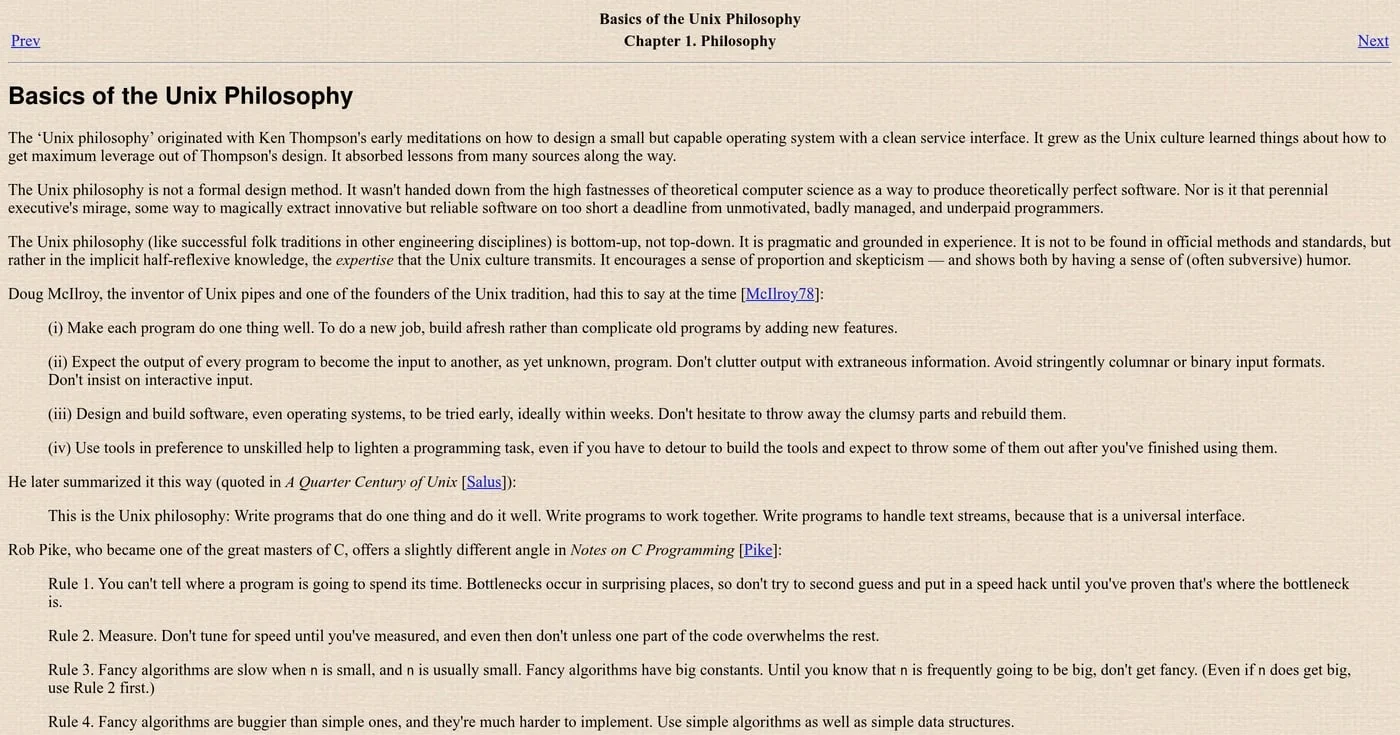
The Unix philosophy is four 1978 rules for small tools, not one slogan. Name the document you quote, then use those rules when you build with agents and tools.