
12 ChatGPT Alternatives With a Specific Edge, Ranked for 2027
12 best ChatGPT alternatives for coding, research, writing and price, from Claude and Gemini to DeepSeek and LibreChat, with prices checked November 2026.
Updated 21 min read


12 best ChatGPT alternatives for coding, research, writing and price, from Claude and Gemini to DeepSeek and LibreChat, with prices checked November 2026.
Claude for writing and long documents, Gemini for the cheapest paid tier, Perplexity for research with citations. ChatGPT is still a strong all-rounder, but its app market share fell from 69.1% in January 2025 to 45.3% in early 2026, per Apptopia data.
The tools below each beat ChatGPT at one specific job, and several are open source or free to use.
ChatGPT remains the default AI assistant for most people. Its current plans run from a free tier with GPT-6 to Plus at $20 a month and Pro from $100 a month, with Codex, deep research and image creation built in. For a general assistant that does a bit of everything, it is hard to beat.
The gap is specialization. Competing tools now lead on specific jobs, and the numbers show people noticing: Apptopia's tracking shows ChatGPT's app market share dropping by about a third in a year. A 4,000-upvote r/ChatGPT thread asking "What are the alternatives?" put Claude and Mistral at the top of the replies.
Common reasons people look for alternatives:
Alternative | Differentiator Tag | Best For | Flagship Model | Paid Plans From | Free Plan |
|---|---|---|---|---|---|
Closest match | Writing, reasoning, long docs | Claude Fable 5.2 | $17/mo (annual) | Yes | |
Budget pick | Google Workspace users | Gemini 4 Carbon | $4.99/mo | Yes | |
Best for research | Cited research, fact-checking | Model choice (GPT, Gemini, Claude, Kimi, GLM, Grok) | $17/mo (annual) | Yes | |
Best for Microsoft 365 | Word, Excel, Outlook users | Not disclosed | $9.99/mo (M365 Personal) | Yes | |
Best for real-time X data | Live news, X discourse | Grok 4.7 | $8/mo | Yes | |
Best for API cost | Cost-sensitive API use | DeepSeek-V4-Pro | Pay per token | Yes | |
Best for coding | IDE-native coding | Model choice | $10/mo | Yes | |
Best for European teams | Work and code agent, EU vendor | Mistral models | $14.99/mo | Yes | |
Best personal agent | Everyday tasks done for you | Muse Spark | Subscriptions for more usage | Yes | |
Best free option | Multi-model access on your infra | Any model you connect | Free (self-hosted) | Yes | |
Best for documents | Source-grounded research | Gemini models | Included in Google AI plans | Yes | |
Best for brand teams | On-brand marketing content | Not disclosed | $59/seat/mo (annual) | No (7-day trial) |
All ChatGPT alternatives compared by use case, flagship model and pricing (November 2026)
The list is ordered from the closest general replacement for ChatGPT to the most specialized tools.
Best ChatGPT alternative for writing, reasoning, and long documents
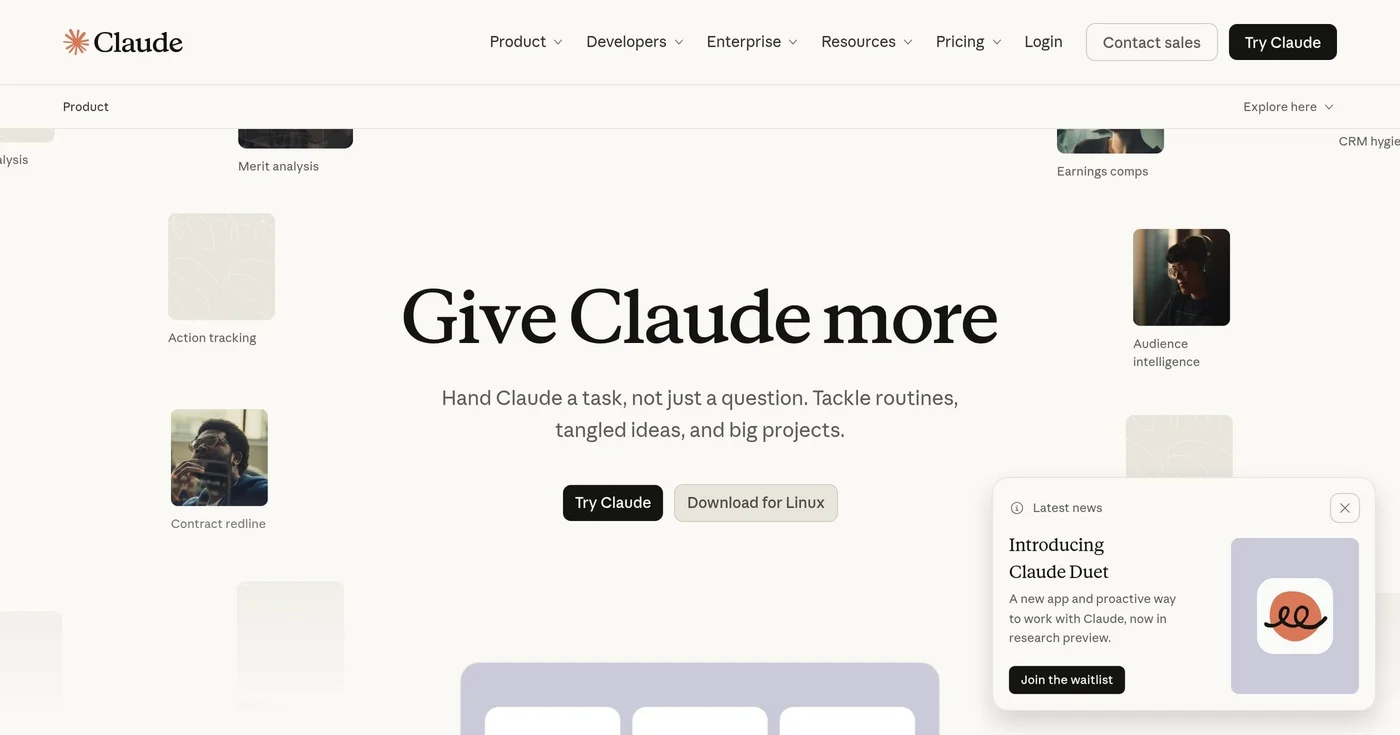
Claude was the top reply in that r/ChatGPT thread, and it is the closest match to ChatGPT's breadth. Anthropic raised $65 billion at a $965 billion valuation in May 2026, and its shares began trading on Nasdaq on November 19, 2026.
The current lineup has four models: Claude Fable 5.2 for demanding reasoning and long-horizon agent work, Opus 5.5 for most workloads, plus Sonnet 5.5 and Haiku 5.5 for speed. Every one of them has a 1M-token context window, so book-length documents and large codebases fit in one conversation.
Paid plans add Claude Code, Research, Projects, and Claude for Microsoft 365 and Chrome. Simon Willison observed in September 2025 that "Claude Code getting a bunch of people onto $200/month plans proved that code is one of the most economically valuable applications of this technology."
For a deeper look at building on the platform, see our guide to the Anthropic API.
ChatGPT has the broader consumer feature set, including image creation in every plan. Claude's edge is long-context work and agentic coding: 1M tokens on every model, and Claude Code included from the Pro plan up.
Free: $0, limited usage every 5 hours and every week.
Pro: $17/month billed annually ($200 up front), or $20 billed monthly.
Max: $100/month, 5x Pro usage, $100 a month in API credits.
Ultra: $200/month, 10x Pro weekly usage, $200 a month in API credits.
API: Fable 5.2 at $8/$40 per million input/output tokens, Opus 5.5 at $4/$20, Sonnet 5.5 at $2/$10.
Best ChatGPT alternative for Google Workspace users and the cheapest paid tier
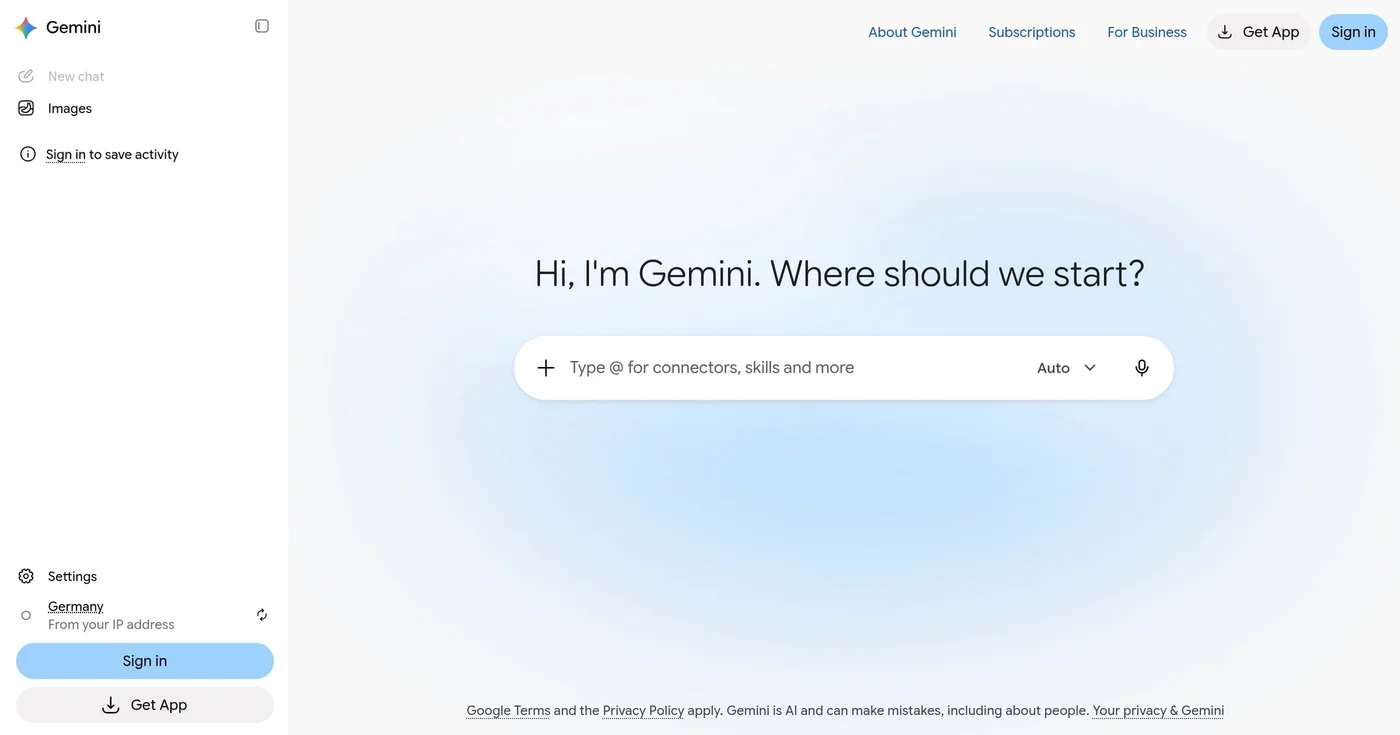
Gemini is the cheapest way into a paid AI plan and the assistant built into Gmail, Docs and Sheets. Google AI Plus costs $4.99 a month and bundles Gemini 4 Hydrogen, Deep Research and 400 GB of storage, shareable with up to five family members.
The Gemini 4 family spans three models. Hydrogen comes with AI Plus, Neon with AI Pro, and Carbon, Google's strongest model, with AI Ultra. Google launched Gemini 4 Neon on November 18, 2026 with a 1 million-token context window, and Pro and Ultra subscribers also get it in Google Antigravity and AI Studio.
Tasks in Gemini is the agent layer: give it a goal and it plans the steps, browses sites and keeps working in the background. Every paid tier gets more access to Tasks, Chrome auto browse, and image, music and video generation.
ChatGPT has the larger third-party ecosystem of custom GPTs. Gemini wins on price and on Google integration: proofreading in Gmail, help in Docs and Sheets, and an AI Overview of your inbox on Pro (US only).
Free: Gemini app.
AI Plus: $4.99/month (400 GB storage, Gemini 4 Hydrogen).
AI Pro: $19.99/month (5 TB storage, Gemini 4 Neon, YouTube Premium Lite).
AI Ultra: from $99.99/month (20 TB storage and up, Gemini 4 Carbon).
Best ChatGPT alternative for research with cited sources
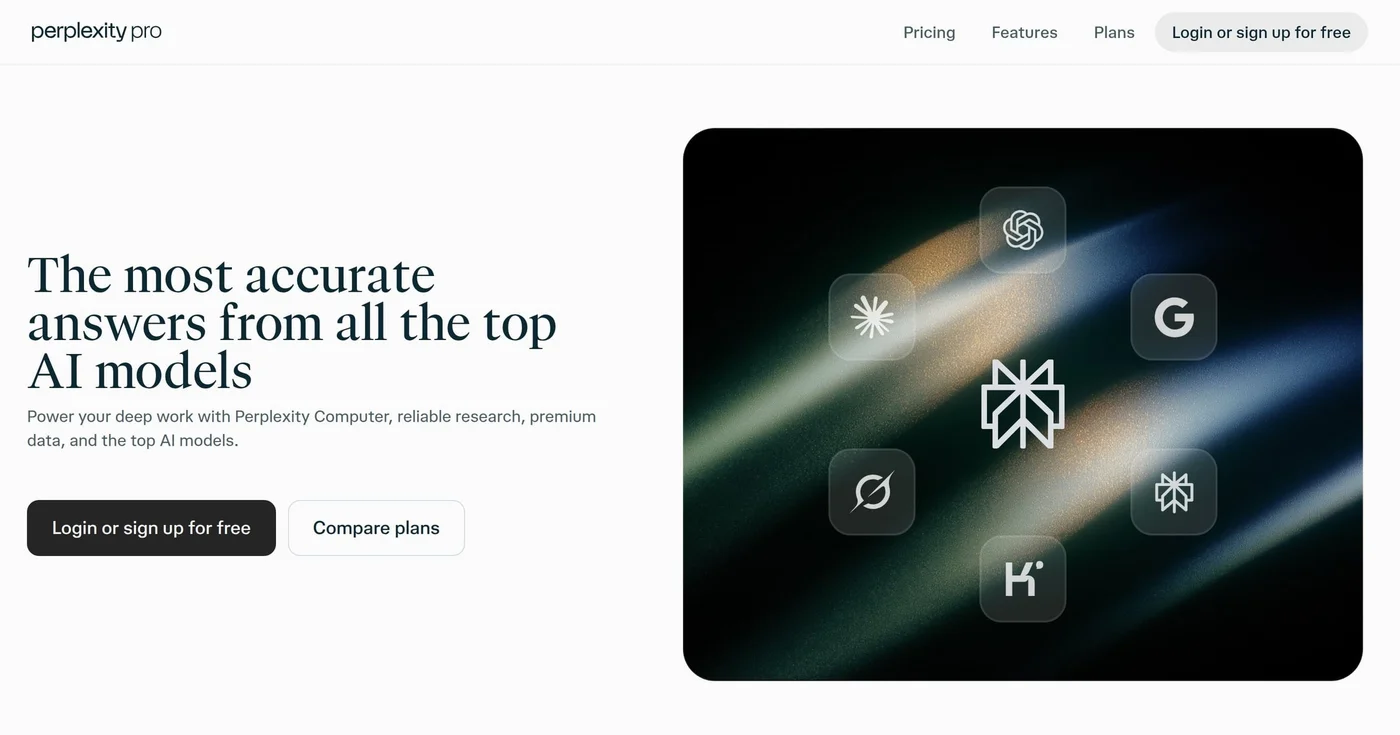
Every Perplexity answer carries numbered citations you can open and check. The Pro plan lets you pick the model, with GPT-6.2 Sol, Gemini 4 Neon, Claude Sonnet 5.5, Kimi K3, GLM 5.3 and Grok 4.7 on the current menu.
Its agent product, Perplexity Computer, builds documents, apps and tools from a prompt and connects to work apps. Perplexity reports that customer Rho cut weekly meeting time by 90% and saved 120 work hours over a 12-week project, with Computer checking Slack, Notion, Jira, Figma and Google Docs for missing tasks.
Sacra estimates Perplexity reached $1 billion in annualized revenue in November 2026, and Nvidia discussed an investment at a valuation above $30 billion, The Information reported in August 2026.
ChatGPT gives longer, more narrative answers and leads on creative work. Perplexity gives shorter, source-backed answers. On the DSQA deep-research benchmark, Perplexity says its Search as Code system scored 0.871 against Anthropic's 0.815, at nearly half the cost per task.
Free: basic answers with limits.
Pro: $17/month billed annually.
Max: $167/month billed annually.
Enterprise Pro: $34/seat/month billed annually; Enterprise Max $271/seat/month.
Best ChatGPT alternative for Microsoft 365 users
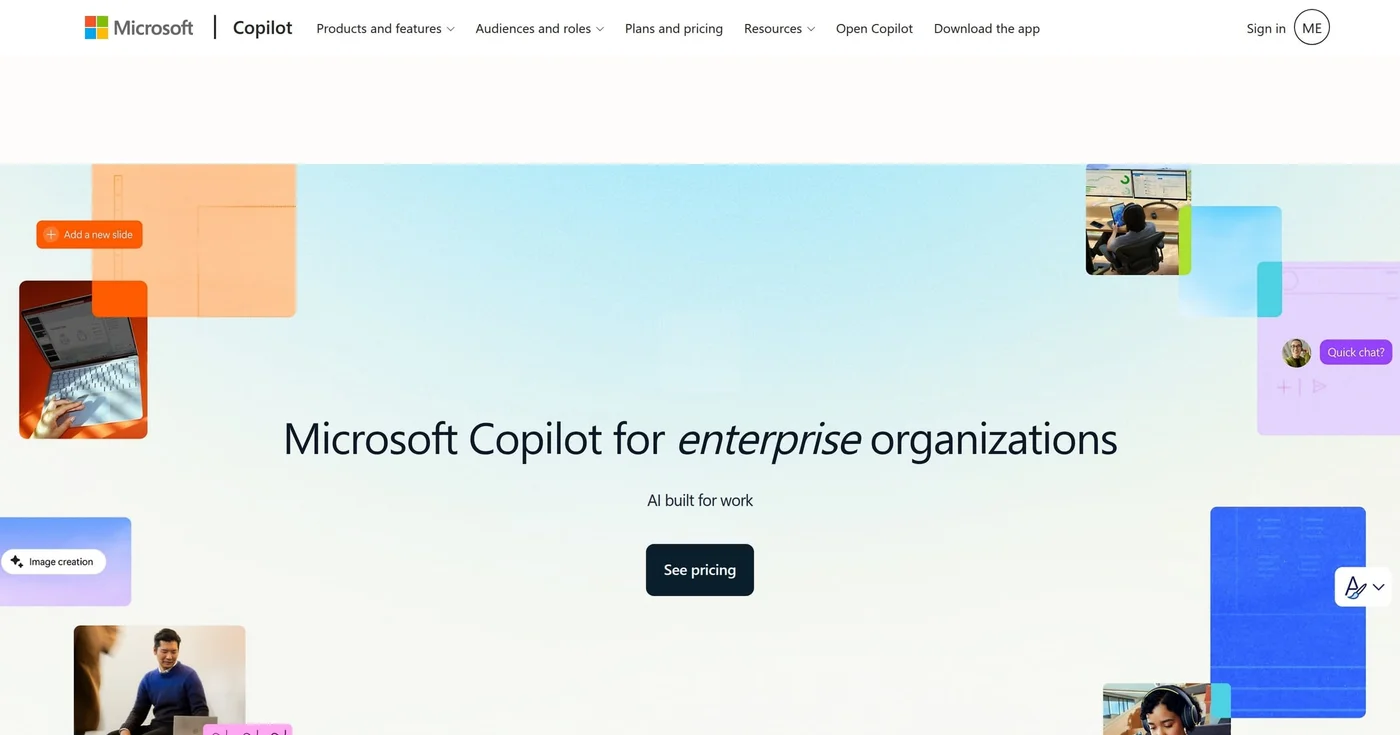
Word, Excel, PowerPoint, Outlook and Teams all have Microsoft Copilot built in. If your documents already live in Microsoft 365, Copilot works on them where they are instead of asking you to paste them into a chat window.
For individuals, Microsoft's plans page now lists Copilot inside four Microsoft 365 subscriptions. Microsoft 365 Personal ($9.99/month) includes advanced Copilot chat with higher usage than free. Premium ($19.99/month, for up to six people) adds the exclusive Copilot features and extensive usage, and the new Microsoft 365 Pro ($99.99/month) has the highest limits.
For companies, the Microsoft 365 Copilot Business add-on is listed at $21 per user per month paid yearly. It adds Copilot in Word, Excel, PowerPoint, Outlook and Teams, AI chat grounded in your work data, and a choice of large language models. Microsoft 365 Business Standard ($23.50) and Business Premium ($32) now come with Copilot built in, and anyone with a work account can try Copilot Chat without a Copilot license.
ChatGPT works on whatever you paste or upload. Copilot works inside the files and mailboxes where the work already lives, grounded in your organization's data on the business plans.
Free: limited Copilot, subject to capacity.
Microsoft 365 Personal: $9.99/month.
Microsoft 365 Family: $12.99/month.
Microsoft 365 Premium: $19.99/month.
Microsoft 365 Pro: $99.99/month.
Microsoft 365 Copilot Business: $21/user/month paid yearly.
Best ChatGPT alternative for real-time X data
Grok's differentiator is X. With its X Search and Web Search tools enabled, it pulls live posts and news into answers, which makes it useful for tracking fast-moving stories and practitioner chatter. The company behind it changed shape in 2026: xAI joined SpaceX in February and now operates as SpaceXSI.
The current flagship is Grok 4.7, released September 21, 2026 for coding and knowledge work. On the API it has a 500K-token context window and costs $2 per million input tokens and $6 per million output tokens.
Pieter Levels shipped a multiplayer game server in February 2025 with code "written almost 100% by AI with Cursor and Grok 3," an early sign of Grok's coding use.
ChatGPT also searches the web, but Grok is the assistant with native X Search. Grok's plans are also cheaper at the entry point: Plus is $8 a month and includes Grok Chat, Voice, Imagine and Build plus API access.
Free: limited chat and agent requests.
Plus: $8/month.
Premium: $30/month (4x Plus usage, latest Grok models).
Super: $100/month (15x Plus usage).
Ultra: $200/month (50x Plus usage).
Teams: $30+/user/month; Enterprise custom.
Best ChatGPT alternative for cost-sensitive and open-weight API use
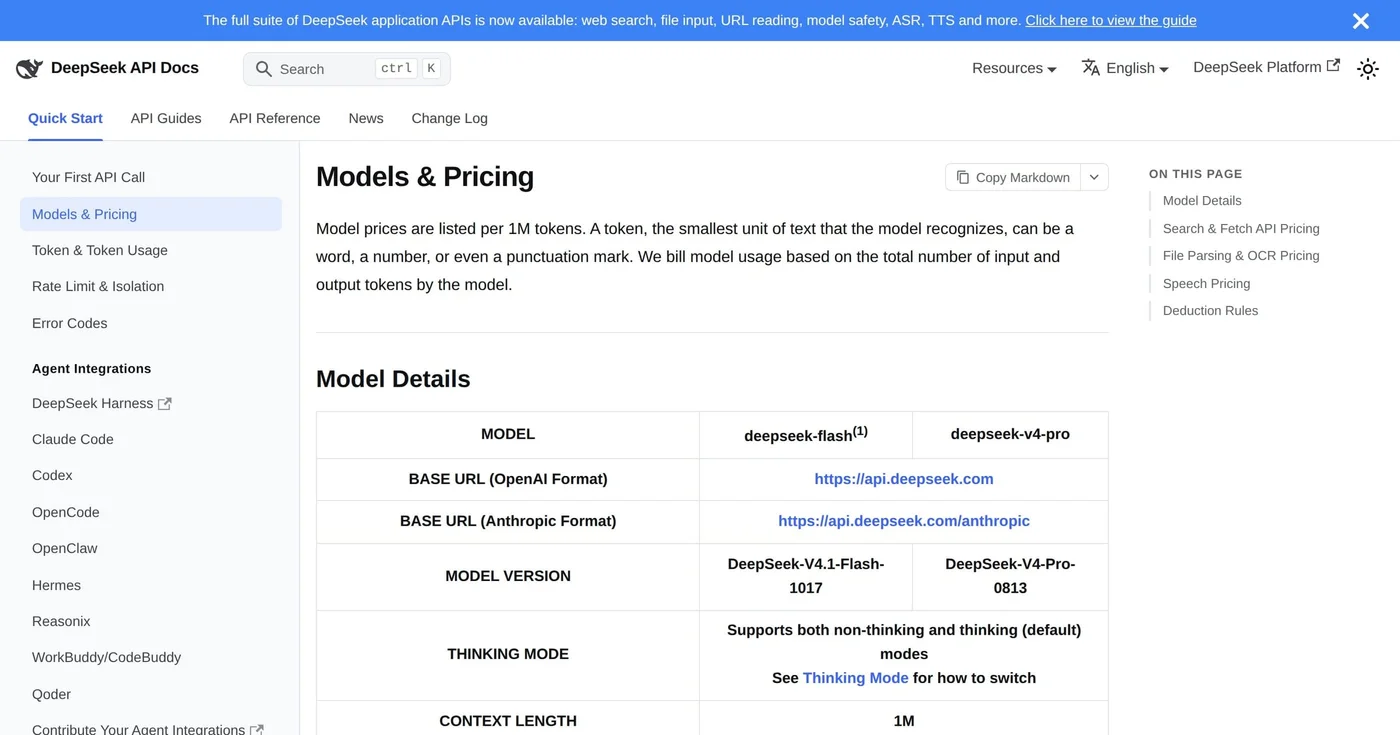
Few frontier-class models cost less than DeepSeek's. DeepSeek-V4 launched in preview on April 24, 2026 in two sizes: V4-Pro with 1.6 trillion total and 49 billion active parameters, and V4-Flash with 284 billion total and 13 billion active. Both support a 1M-token context, now the default across DeepSeek's services.
The weights are open. The V4-Pro model card on Hugging Face lists an MIT license, so you can self-host and fine-tune it.
DeepSeek's pricing page lists the Flash model, now served by DeepSeek-V4.1-Flash, at $0.30 per million input tokens and $1.20 per million output tokens at peak, halved off-peak.
V4-Pro costs $1.32 input and $3.96 output at peak. For comparison, Claude Opus 5.5 is $4 and $20.
The web chat at chat.deepseek.com is free.
ChatGPT has the more polished app, voice and image creation. DeepSeek has far lower API costs, MIT-licensed weights, and an API that supports both the OpenAI ChatCompletions and Anthropic formats.
Free: web chat.
API, deepseek-flash: $0.30/M input, $1.20/M output at peak; $0.15 and $0.60 off-peak.
API, deepseek-v4-pro: $1.32/M input, $3.96/M output at peak; $0.66 and $1.98 off-peak.
Self-hosted: free under the MIT license.
Best ChatGPT alternative for IDE-native coding
GitHub Copilot is the coding specialist on this list. It works inside your editor with code completions, next edit suggestions and agent mode, and it runs in the cloud for code review and longer tasks. Pro also gives you model selection and access to third-party agents, Claude Code and Codex, inside GitHub.
Billing now runs on GitHub AI Credits: every plan includes a monthly allowance, and one credit equals $0.01. A quick question to a light model uses a fraction of a credit; a long agent session on a frontier model across many files uses more. Pro includes $15 of credits a month, Pro+ $70, and Max $200.
Shawn Wang (@swyx) joked in September 2024 about how normal this has become:
"I saw an AI engineer today. No cursor. No claude 3.5 sonnet. No aider. He just sat there. Coding without running an LLM every other minute. Like a psychopath."
If you are choosing between agentic coding tools, our Cursor vs Claude Code guide goes deeper.
ChatGPT has Codex, but everyday coding with it still means switching between a chat window and your editor. Copilot runs inline, understands the files you have open and plugs into pull requests and code review on GitHub.
Free: 2,000 completions/month, Haiku 4.5 and GPT-5 mini.
Pro: $10/month ($15 in monthly credits).
Pro+: $39/month ($70 in credits).
Max: $100/month ($200 in credits).
Business: $19/seat/month.
Enterprise: $39/seat/month.
Best ChatGPT alternative for European teams that want one agent for work and code
On May 28, 2026, Le Chat became Vibe, "one agent and one licence across work and code," with every conversation, setting and plan carried over.
Work Mode handles inbox, calendar, research and document tasks across Google Workspace, Outlook, SharePoint, Slack and GitHub. Code Mode runs remote coding agents that ship reviewable pull requests.
Mistral, the European option on this list, is well funded. It raised €3 billion in a Series D at a post-money valuation of more than €21 billion, led by Samsung Electronics. Mistral calls it the largest equity round ever completed by a European technology company, and its pitch is sovereign, open-weight AI.
Community interest predates the rename. In that r/ChatGPT "What are the alternatives?" thread, a bare link to Mistral's chat drew 415 upvotes, just behind the top reply, "Claude," at 418.
ChatGPT has the bigger ecosystem and more polished voice and image features. Vibe gives you a European vendor and CLI, IDE and web coding in the same plan.
Free: limited messages, web searches and coding sessions.
Pro: $14.99/month (verified students pay $5.99).
Team: $24.99/user/month.
Enterprise: custom.
Best ChatGPT alternative for a personal agent that does the work
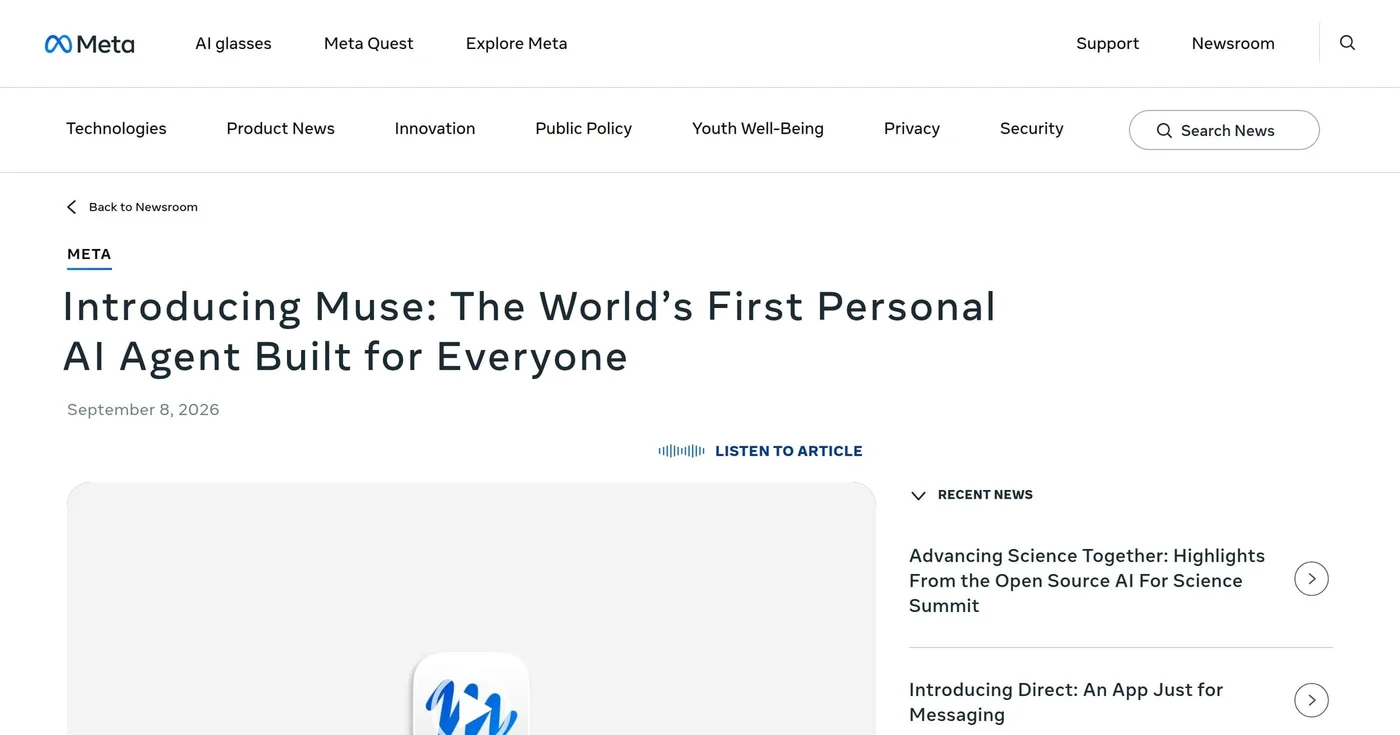
Muse is Meta's answer to the assistant-as-agent trend. Meta introduced Muse on September 8, 2026 as "a secure, private personal AI agent that proactively helps with people's goals and suggests ideas." You tell it what needs doing and it acts, powered by Meta's Muse Spark model.
Each user's Muse runs on its own Muse Secure VM, a dedicated cloud computer that stores the data and credentials for connected services. A separate Sentinel agent on the same machine must approve anything Muse sends to the internet, and Muse checks with you before sensitive actions like sending an email or making a purchase.
It cannot see your passwords or payment methods, keeps an audit trail of what it has done, and Meta says your conversations and VM data are not shared with its ad systems.
You choose which apps Muse connects to and how much access it gets, for example whether it can only read your email or also send on your behalf. Muse is rolling out in the US on iOS, Android and muse.ai, with AI glasses support coming. Meta says it is free for most of what people need, with subscription plans for heavier use.
ChatGPT is a broad assistant with agent features added. Muse is built agent-first, with a dedicated VM and a separate approval agent between it and the internet.
Free: most everyday use.
Subscriptions: available for people who want to do more; Meta's announcement did not list prices.
Best ChatGPT alternative for multi-model chat on your own infrastructure
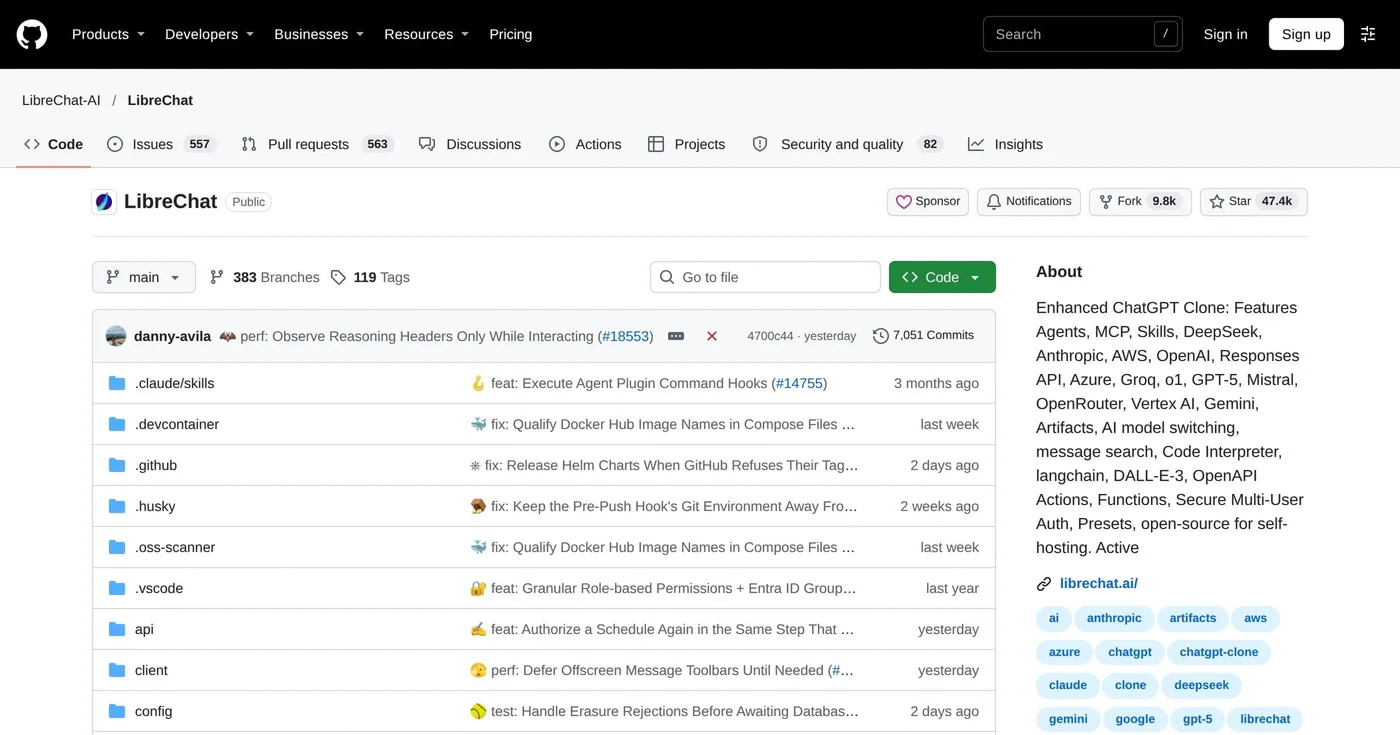
Think of LibreChat as an open-source, ChatGPT-style interface you run yourself. Its GitHub repository describes it as an "Enhanced ChatGPT Clone" with agents, MCP, skills, artifacts and model switching across OpenAI, Anthropic, Gemini, Mistral, DeepSeek, OpenRouter, Groq, AWS, Azure and Vertex AI. You pick the model per conversation, and the UI looks and feels like ChatGPT.
The project has a corporate backer now. ClickHouse acquired LibreChat on November 4, 2025, bringing founder Danny Avila and his team in-house, and the repository is still MIT licensed. The newest release, v0.8.9, adds Gemini 4 Hydrogen, GPT-6.1 Terra and Claude Fable 5.2, MCP Apps, clearer tool approvals, and Chat Projects with shared instructions and reference files.
The cost case comes from users. u/opensourcecolumbus replaced ChatGPT Plus with LibreChat on r/selfhosted in 2025:
"I found it to be a reliable replacement of ChatGPT Plus, as it has all the features I use in ChatGPT Plus with similar UX. That led to zero learning curve, instantly replacing $20 cost to API usage based cost ($3 for my moderate usage)."
ChatGPT is simpler to start and ties you to OpenAI's models and prices. LibreChat needs a server or Docker, but gives you every major model in one interface and pay-per-use API pricing.
Self-hosted: free (MIT license); you pay each model provider for API usage.
Best ChatGPT alternative for document-grounded research
Gemini Notebook answers from the sources you give it. Google renamed NotebookLM to Gemini Notebook on July 16, 2026. It stays a standalone product, now synced with the Gemini app and used by more than 30 million people and over 600,000 organizations, according to Google.
You upload PDFs, docs, links and other sources, then ask questions across the whole set. Google says responses are always grounded in the information you provide. The tool turns those sources into Audio Overviews, Video Overviews, reports, flashcards, infographics and slides.
The July update also gave every notebook a secure cloud computer that writes and runs code for data analysis. It launched for Google AI Ultra users and was set to roll out to Pro users on the web.
For students, analysts, lawyers and researchers who need answers tied to their own material, it is the closest match on this list.
ChatGPT answers from its training data and the web. Gemini Notebook answers from your sources, so every claim traces back to a document you chose.
Free: up to 50 sources per notebook, standard generations.
Google AI Plus: up to 100 sources, double the standard usage limits.
Google AI Pro: up to 300 sources, four times the standard usage limits.
Google AI Ultra: up to 600 sources, 5 to 20 times the Pro usage limits.
Best ChatGPT alternative for enterprise brand marketing teams
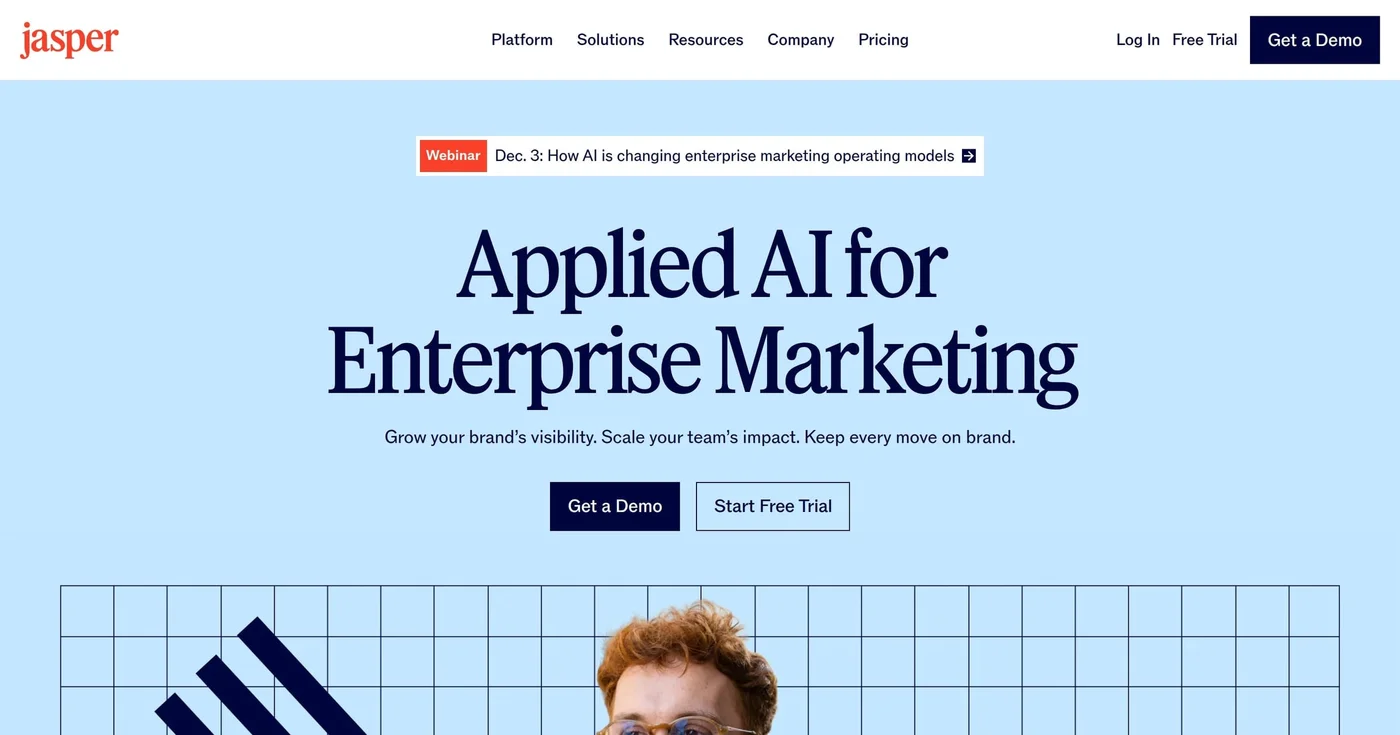
Jasper does one thing: marketing. Jasper says its IQ layer "embeds your brand voice, style guides, audience profiles, and product knowledge into every output, across your entire team, automatically," so nobody has to paste them into each prompt.
It is not a general-purpose ChatGPT replacement. The Pro plan costs $59 per seat per month billed yearly, or $69 monthly, and includes one seat with the Canvas platform for on-brand content. Business is custom-priced and adds secure, flexible deployment options.
For a 10-person content team with real brand consistency requirements, that premium can pay off. For a solo writer, $59 to $69 a month versus $17 to $20 for Claude Pro or ChatGPT Plus needs a hard look at the productivity difference.
ChatGPT keeps a brand voice only if you set it up yourself in custom instructions or GPTs. Jasper bakes brand, product and audience context in at the account level, so every team member works from the same rules.
For enterprise marketing teams, that infrastructure has value. For individual or technical users, it does not.
Pro: $59/seat/month billed yearly, $69 monthly (1 seat).
Business: custom pricing.
Match the tool to the job instead of hunting for one replacement. Claude handles writing and long-context reasoning, GitHub Copilot stays in the IDE, Gemini covers Google Workspace, and Perplexity handles anything that needs a citation. ChatGPT is still a solid all-rounder if you want one tool for everything, but its fall from 69.1% to 45.3% app share shows how many users have already spread their work across several.

Gemini wins on price, storage and Google apps; ChatGPT wins on coding and agent access. Plans, models and team seats compared, checked 27 Nov 2026.

A practical Gemini API guide for teams: AI Studio keys, Gemini 4 model choice, free-tier limits, the 1 December 2026 price change, and Vertex versus Firebase.

12 AI browsers compared on agent features, privacy, platforms and real prices, with what changed after ChatGPT Atlas and Arc shut down.
